
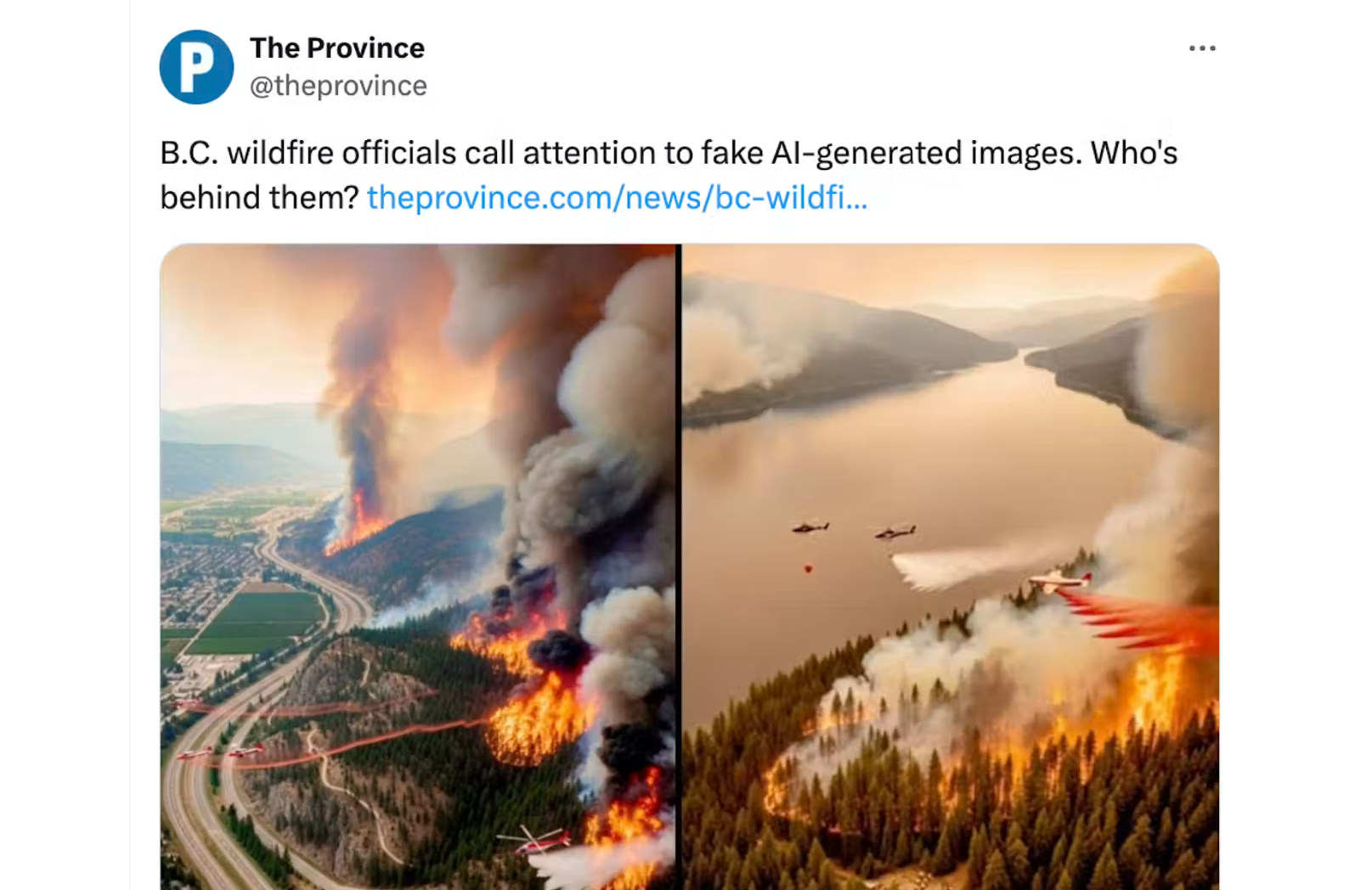
AI-Generated Imagery During Emergencies
In Aug 2026, we looked at how extreme weather events such as floods and wildfires create both operational disruption and material for opposition campaigns. This week's read builds on those concepts. Fabricated images and maps of emergencies often circulate alongside official information, sometimes reaching people before the official story does. Some of it is created to push a narrative, and some of it is produced to drive online engagement. Either way, organizations responding to an incident are often competing with misinformation that distracts from the real story.
What Type of Misinformation is Circulating
The clearest evidence of this trend in Canada comes from wildfire seasons. On Apr 21, 2026, the British Columbia Wildfire Service warned the public about AI-generated wildfire imagery circulating online, including a fabricated image of a helicopter near a smoke plume that had been falsely attributed to the agency itself. A similar warning was issued the year before. Across the 2026 season, false evacuation figures, fire maps with geography that does not exist, and false air quality and closure notices spread widely. Agencies spent staff time correcting the material rather than on response.
Statistics Canada reported in May 2026 that 43 percent of Canadians find it harder to distinguish accurate information from misinformation than they once did. During an emergency, when people are searching for information quickly and sharing what they find, that has a more immediate effect.
Where It Comes From
Most of this content is not produced by organized opposition. Campaign groups have a strong incentive to avoid fabrication, because being caught inventing evidence would undermine the rest of their claims. The material traced so far comes from engagement and advertising revenue networks, from content farms that generate large quantities of material based on whatever is trending, and from ordinary users reposting something that looked plausible.
The problem is that once an image exists, anyone can use it. A fabricated photograph of a fire near an industrial site does not need to have been made for a campaign to end up attached to one, and the people sharing it usually believe it is real. The distinction between deliberate and accidental misinformation matters for attribution, but not for effect.
Why This Matters Operationally
The first effect is on the operating picture. Staff, contractors, and their families make decisions during an emergency based on what they can see, and fabricated evacuation notices or closure information can pull people in the wrong direction or generate calls that a site team has to answer while managing an actual event.
The second is on communications. An organization issuing a factual update during an incident is competing with material designed to hold attention. The accurate version is slower to produce, less dramatic, and reaches a smaller audience.
The third is impersonation. If imagery can be falsely attributed to a provincial agency, it can be falsely attributed to a company. Any communication bearing a company's logo and formatting can be reproduced convincingly, and during an emergency, few people will stop to verify it.
What Organizations Can Do
Incident communications should be built around a single authoritative source that staff and the public are directed to in advance, so that verification does not depend on recognizing a fake. Emergency notifications benefit from a consistent, known format, which makes a fabricated version easier to identify. Staff who are likely to be asked about an incident should know where to point people and should be told not to engage with disputed material directly.
It is also worth deciding in advance who is responsible for watching what is circulating during an event. That work competes with incident response itself, and in practice it is either assigned beforehand or it does not happen.
The Role of Digital Investigative Intelligence
Monitoring during an incident shows what is circulating about a site while the event is ongoing, which images are gaining traction, and whether anything is being attributed to the organization that did not come from it. It also indicates when material has moved from general circulation into campaign or community channels, which is the point at which a fabricated image can bolster an argument about a specific project.
Conclusion
While organized opposition groups tend to avoid using fabricated imagery, it is still circulated by individuals, content farms, and others who benefit from online attention. During an incident, the first account of what is happening tends to be the one people remember, which makes it easy for misinformation to spread. An organization that can point to a known, authoritative source for updates is in a better position than one issuing its first update into an argument that has already formed. This is preparation that must be done in advance, because the capacity to do it disappears once a real emergency is underway.